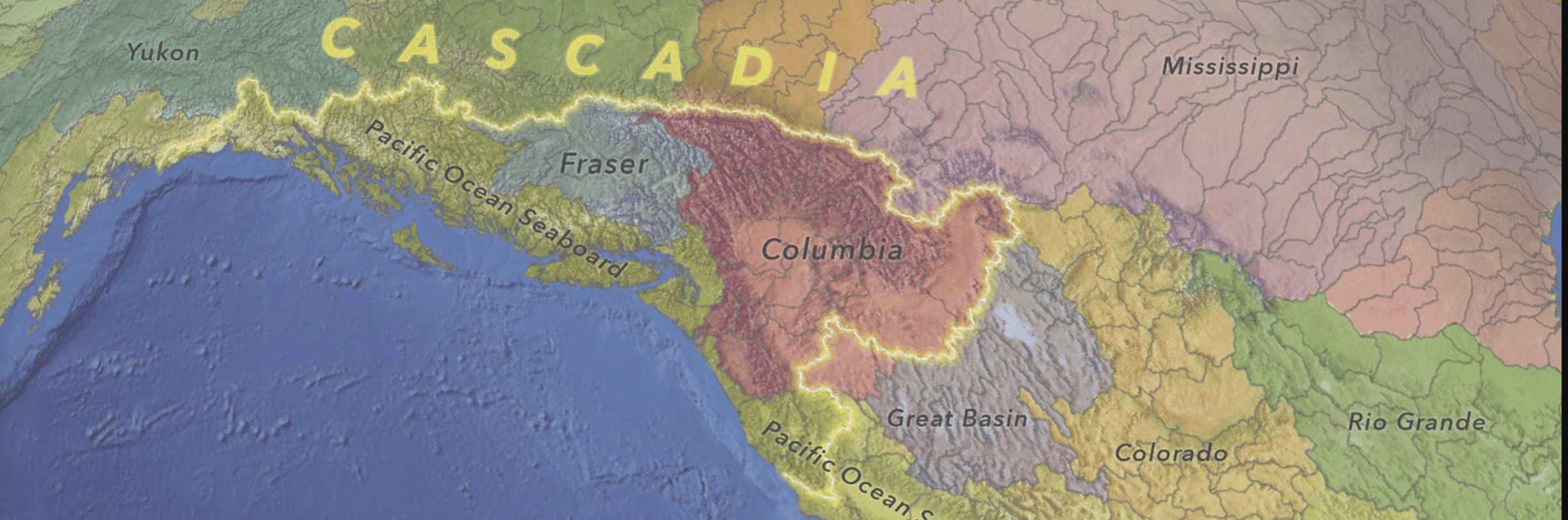
What would it look like to regenerate your bioregion? This is the question that Regenerate Cascadia posed as it launched its Bioregional Activation tour in 2023. At the heart of the question is the relationship between people and place, which has been a key part of my professional practice and life.
For as long as I can remember, I’ve paid close attention to the places I’ve lived—from growing up by the beach and running cross-country through my hometown, to exploring trails and mountains as a camp counselor in Washington. My interest deepened while studying urban planning at the University of Oregon, where I became fascinated by local environmental history and politics. Later, while living at the Los Angeles Eco-Village, I immersed myself in community-based projects like permaculture, composting, the Bike Kitchen and consensus decision-making. My ecological awareness took root in childhood, nurtured in my grandmother’s garden in the Bay Area, and grew stronger in college as I became especially drawn to regenerating cities through climate-friendly, active transportation and the creation of healthy, resilient communities.
Given all this, when I came across Regenerate Cascadia last year, their mission immediately resonated with me. I’ve always been drawn to the concept of bioregionalism—that unique intersection of place and people. I’ve also long been drawn to the Cascadia Bioregion, a place rich in natural, working, and Indigenous lands, and with a history of policies and practices supporting sustainable cities.
When I learned about Regenerate Cascadia’s Bioregion Activation Tour and Bioregional Summit—after they had already wrapped up—I eagerly listened to all of the recordings and joined the network of regenerators. I attended a summer potluck and began conversations with one of Regenerate Cascadia’s co-founders, Brandon Letsinger.
When Brandon and I found time to meet in person, he gave me a copy of Samantha Power’s recently released book, Bioregional Financing Facilities. I read it cover to cover and was struck by how philanthropy plays an important role in the funding ecosystem that supports place-based, regenerative work throughout the bioregion.
Having consulted for The Funders Network for the past ten years, I offered to help imagine what a Bioregional Financing Facility could look like in the Cascadia Bioregion. I’m thrilled to share that I’ve joined the Regenerate Cascadia team and am helping organize a Forum on Bioregional Finance to support regenerative projects throughout Cascadia. This will build upon the BioFi Conference Regenerate Cascadia is hosting May 16-18 in Seattle, Washington.
Alongside Brandon, I’ve joined the BioFi Project’s BioFi Cultivator Cohort, and we’re well on our way to designing a Cascadia Regeneration Fund! The vision for this—and other related Bioregional Financing Facilities—is to provide mechanisms that support communities on the ground in trust-based ways, empowering regenerative projects.
As part of this work, I’ve started reaching out to folks in philanthropy to learn more about the kinds of regenerative projects they are funding and to gather feedback on this concept.
It’s exciting to be part of a growing movement focused on local, regenerative solutions, and I look forward to connecting with more leaders across Cascadia. To learn more, here are a few links:
- Regenerate Cascadia
- BioFi Conference (May 16-18, Seattle, WA)
- Cultivating a Cultural Shift to Bioregional Resilience

 Ron Milam Consulting